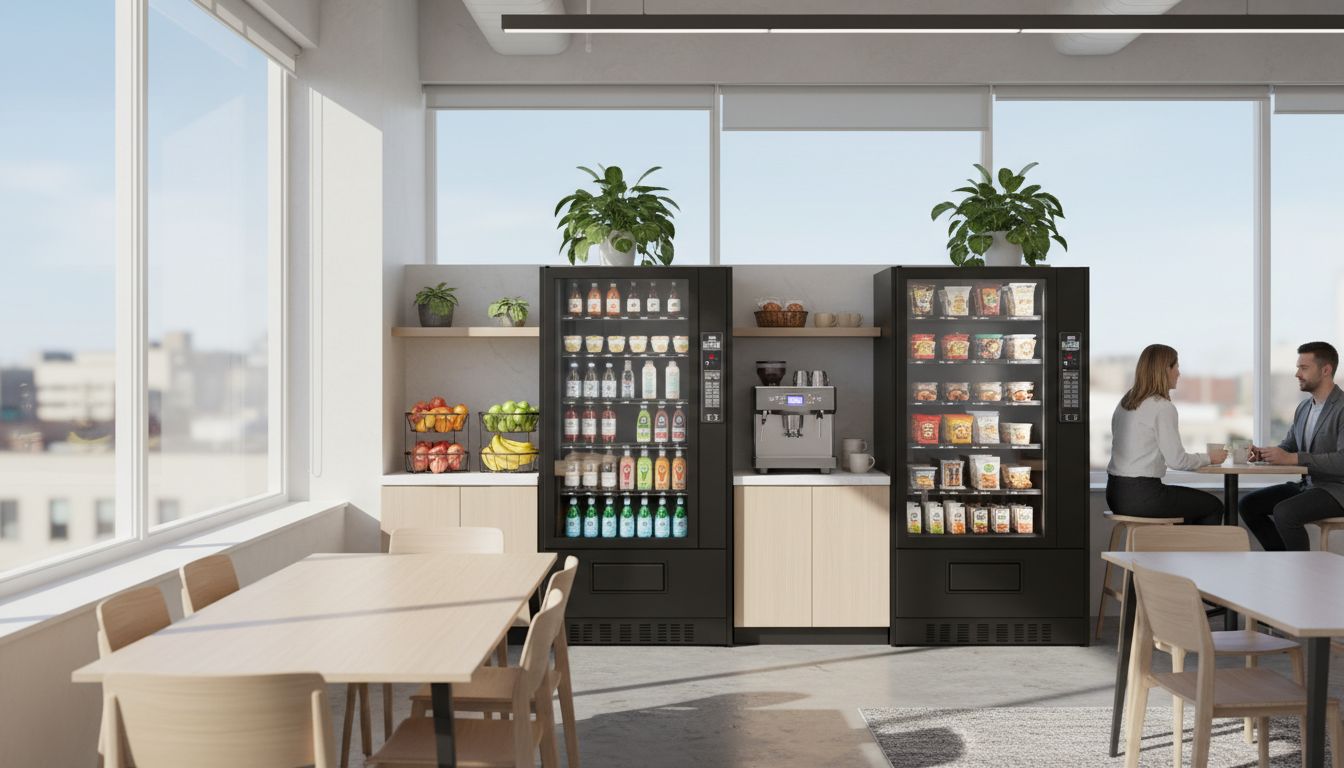
If you are pricing a break room for a Chicago office, the real answer depends on which model you are buying, not on a single dollar figure. Purchasing machines outright is a capital expense with published equipment ranges you can look up. Bringing in a full-service vending operator is a different cost structure entirely, and most offices land there once they see what owning the hardware actually involves.
- If you buy the machines, industry trade sources put new units at roughly $3,000 to $6,000 each and refurbished units around $1,200 to $3,000.
- In a full-service vending program the operator owns, installs, services and restocks the equipment, so the office is not purchasing hardware.
- Your actual number is confirmed in a written walkthrough quote based on headcount, traffic and the product mix you want.
- Chicago building realities - dock and freight elevator access, insurance paperwork, tight break rooms, power and data - move installation within those ranges.
- Yami Fresh serves Chicago and nearby suburbs including Des Plaines, Franklin Park, Elk Grove Village and Melrose Park.
The situation
Here is a scenario that plays out constantly. A 60-person Chicago office signs a new lease. The break room has a sink, a fridge and a wall of empty floor space, and the office manager is asked for a break room number before the build-out budget closes.
So they start shopping machines, and the quotes come back higher than expected. That is before anyone has solved the harder problem: who drives to a warehouse club every week, hauls cases up the elevator, and notices when the machine jams on a Tuesday afternoon.
At that point the question quietly changes. It stops being "what does a machine cost" and becomes "what does a stocked, working break room cost to keep running."
What the equipment costs if you buy it yourself
This is the number most people find first, so it is worth knowing. Trade sources that track the industry - the National Automatic Merchandising Association and Automatic Merchandiser, publisher of the annual State of the Industry report - generally describe new snack or beverage machines in the low-to-mid four figures, roughly $3,000 to $6,000 each, with smart and cashless models at the upper end, and refurbished units commonly around $1,200 to $3,000 (NAMA and Automatic Merchandiser).
Treat those as purchase prices only. They do not include delivery and placement, cashless card reader hardware and payment processing fees, the first full product load, or anyone's time keeping it stocked.
| What you are pricing | Typical published range | Who owns and services it |
|---|---|---|
| New snack or beverage machine, purchased | Roughly $3,000 to $6,000 each | Your company |
| Refurbished machine, purchased | Roughly $1,200 to $3,000 each | Your company |
| Cashless card reader added to a purchased machine | A few hundred dollars plus processing fees | Your company |
| First full product load per machine | Varies with the mix you choose | Your company |
| Full-service vending placement | Scoped in a written walkthrough quote | The operator |
| Micro market build-out | Scoped in a written walkthrough quote | Varies by program |
What the process looks like
A full-service program is scoped before anything is priced, because the space decides half of it. The sequence is usually:
- Walkthrough. Someone looks at the actual room - floor space, outlets, network access, headcount, shift patterns, guest traffic and how deliveries reach the floor.
- Program design. Vending machines, a micro market, a cashless pantry, office coffee service, or a combination. A 20-person office and a 200-person office rarely want the same thing.
- Written quote. This is where your number lives. It spells out the program, the product mix, and what the company covers versus what employees pay at the machine.
- Install day. Delivery and placement, power and network connection, cashless payment setup, and the first full stock.
- Ongoing service. Restocking and machine service on a schedule set when the program is scoped, adjusted as you learn what actually moves.
What to expect afterward
The first few weeks are data. Cashless vending records what sells, and the planogram gets corrected - the sparkling water doubles, the item nobody touched comes out, the protein bars get a second row.
That is the part a purchased machine cannot do for you. A self-stocked machine sells whatever you guessed in month one, forever, while a serviced program keeps converging on what your team reaches for.
Offices that outgrow the footprint usually move up rather than out, replacing a bank of machines with a micro market, or adding a cashless pantry where the company subsidizes snacks instead of employees paying per item.
What moves the number in a Chicago building
- Access. Loading dock windows, freight elevator reservations and certificate-of-insurance requirements all shape install day, especially in managed downtown towers.
- Room size. Older Chicagoland buildings often have narrow break rooms where a micro market layout fits better than a machine bank.
- Power and data. Cashless hardware needs a reliable connection, and some rooms need an outlet added.
- Traffic. Headcount, shifts and guest volume drive product movement, which drives how a program is scoped.
- Product mix. A mix weighted toward fresh and better-for-you items prices differently than shelf-stable candy and chips.
Get the number for your break room
The published ranges above tell you what buying equipment costs. The only figure that matters for your office comes from a walkthrough of your actual space and a quote in writing.
Call Yami Fresh at (847) 423-2448 or reach us at 8141 Austin Ave., Morton Grove, IL 60053. We serve Chicago along with Des Plaines, Franklin Park, Elk Grove Village, Northlake, Melrose Park, Itasca, Westchester, Lombard and Bedford Park.
Frequently Asked Questions
Is there a cost to have vending machines installed in our Chicago office?
It depends on the model. If your company purchases the machines, that is a capital expense, with industry trade sources putting new units at roughly $3,000 to $6,000 each and refurbished units around $1,200 to $3,000. In a full-service program the operator owns and services the equipment instead, and what your office pays is confirmed in a written quote after a walkthrough. Call Yami Fresh at (847) 423-2448 to set one up.
How many employees do we need before vending makes sense?
There is no single headcount. What matters is product movement, which comes from headcount, shift patterns and guest traffic, and that is exactly what a walkthrough measures. Smaller offices often fit a cashless pantry or a compact micro market better than a bank of machines.
Who stocks and services the machines?
In a full-service vending program, the operator handles stocking, machine service and product rotation, so nobody on your staff is making warehouse club runs. The service scope and schedule for your site are set in writing when your program is scoped.
Can our company pay for snacks instead of employees paying at the machine?
Yes, that is the cashless pantry model, where the company subsidizes or fully covers snacks and beverages and employees check out without paying. Ask for it when your program is quoted, since it changes how the cost is structured.
Do you serve downtown Chicago offices or only the suburbs?
Yami Fresh is based at 8141 Austin Ave., Morton Grove, IL 60053 and serves Chicago along with Des Plaines, Franklin Park, Elk Grove Village, Northlake, Melrose Park, Itasca, Westchester, Lombard and Bedford Park.
Ready to Upgrade Your Office Break Room?
Yami Fresh helps Chicagoland businesses build snack, micro market, office coffee, and vending programs their teams actually love. Tell us what you need and we’ll design a program that fits.
Talk to Our Team