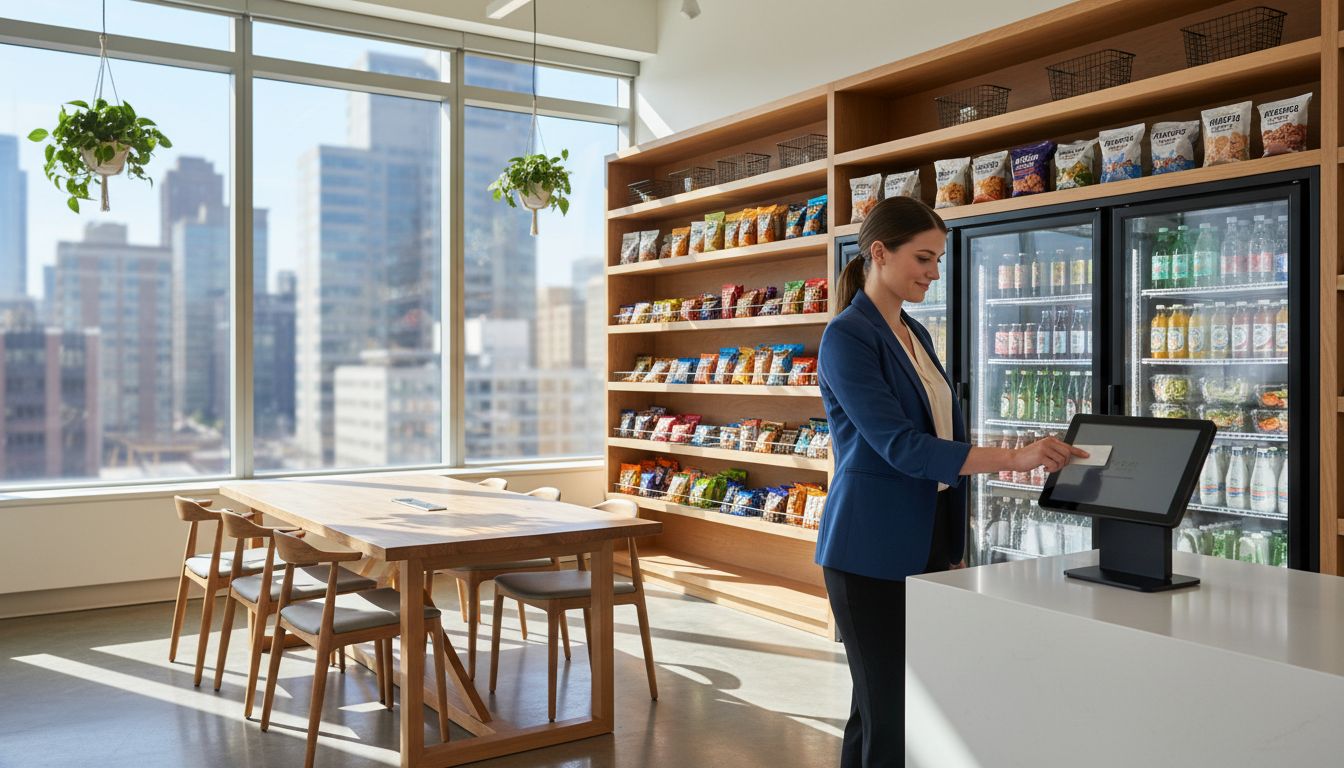
Short answer: a micro market is an unattended, self-checkout mini convenience store built right into your break room - open shelving, glass-door coolers and freezers, and a touchscreen kiosk (or phone app) where employees scan an item and pay cashlessly. For most Chicago offices with a real on-site headcount and a dedicated, employee-only break room, a micro market beats vending on selection, fresh food, and how the space feels. Vending machines still win when the room is small, shared with visitors or the public, or tight on wall space and power.
- A micro market is open-shelf retail plus a self-checkout kiosk - no glass, no coils, no coin slot.
- Micro markets carry far more fresh and healthy options than a machine can hold, including salads, wraps, yogurt and frozen entrees.
- Vending is the better fit for small teams, tight corners, and lobbies or shops where non-employees have access.
- Security comes from a closed employee-only space, cashless accounts and camera coverage - not from locked glass.
- Many Chicagoland offices run both, plus coffee service, in the same room.
How a micro market actually works in a Chicago office
A micro market replaces the machine with a small retail footprint. Your provider builds out shelving and coolers, stocks them, and installs a self-checkout station - so employees pick items up, look at them, read the label, and put one back if they change their mind.
The day-to-day flow is simple:
- Browse openly. Snacks sit on shelves, drinks and fresh food sit in glass-door coolers, and frozen meals sit in a freezer case.
- Scan at the kiosk. The employee scans each barcode at a touchscreen terminal.
- Pay cashlessly. Card, mobile tap, or a preloaded market account - no bills, no coins, no "the machine ate my dollar."
- Grab and go. Total time is usually shorter than a trip down the elevator and around the block.
Behind the scenes, your provider owns the equipment, tracks what sells, and handles replenishment on a schedule built around your office's volume and hours. Nobody on your staff counts inventory or runs to a warehouse club.
Security is the question every Chicago facilities manager asks next. Micro markets rely on a controlled, badge-access break room, individual cashless accounts tied to real people, and camera coverage of the checkout area. That is a different model than locked glass - which is exactly why the room it lives in matters so much.
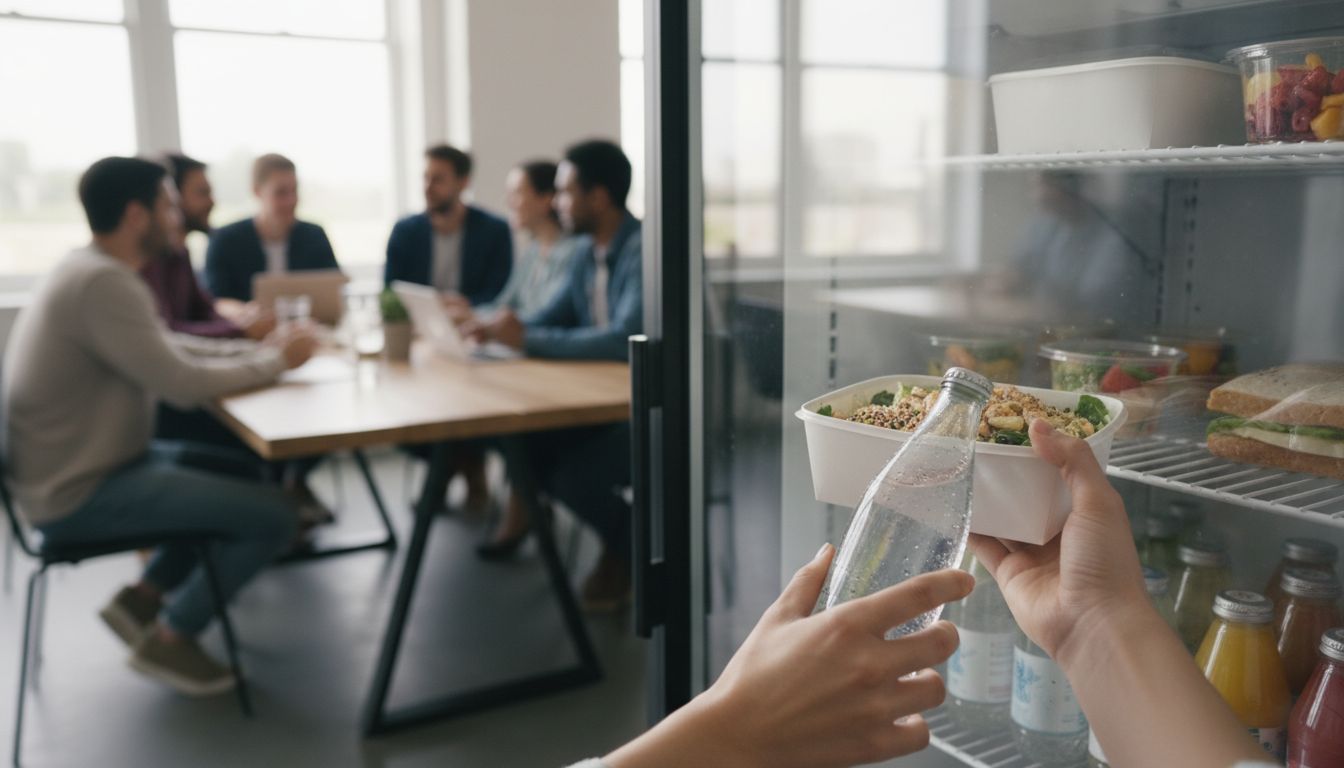
Micro Markets vs Vending Machines
Both are unattended, both are cashless-capable, and both can be built around healthier options. The differences show up in footprint, product range, and who is allowed in the room.
| Criteria | Micro Market | Vending Machines |
|---|---|---|
| Cost and commitment | Higher build-out - shelving, coolers, freezer and kiosk. Priced per program; ask for a quote based on your headcount and space. | Lower barrier. One or two machines can be placed in an existing corner with far less planning. |
| Space needed | Needs an actual room or a defined break room zone with wall space and power for multiple cases. | Fits a hallway alcove, a corner, or a shared vestibule. Scales down to a single machine. |
| Timeline to launch | Longer - site walk, layout, equipment placement, kiosk setup and account onboarding. | Faster - placement and stocking, with far fewer moving parts. |
| Product range | Widest. Fresh salads, wraps, yogurt, fruit, frozen entrees, better-for-you snacks, full beverage variety, and larger package sizes. | Limited by coil and tray geometry. Excellent for snacks and bottled or canned drinks, narrower on genuinely fresh items. |
| Employee experience | Feels like a store. Employees read nutrition labels before buying, which pushes healthier choices. | Feels like a transaction. Quick and familiar, but selection is what you see through the glass. |
| Security profile | Depends on a controlled employee-only room, named cashless accounts and cameras. | Self-contained. Product stays locked behind glass, so open or public access is not a problem. |
| Longevity and flexibility | Planograms change easily - swap a whole shelf when tastes change or wellness goals shift. | Durable and proven, but changing the mix means working within the machine's slots. |
| When it makes sense | Larger on-site headcount, dedicated break room, appetite for fresh food, culture and retention are priorities. | Smaller teams, multiple scattered break areas, shared or semi-public spaces, tight footprints, 24-hour shift coverage. |
Which is right for your break room
Work through these in order - the answer usually falls out after the first two.
- Is the break room employee-only? If clients, delivery drivers, or the public can walk in, go with vending machines. Open shelving in a semi-public room is a losing proposition.
- Is there a real crowd on site? Micro markets earn their footprint when enough people are in the building daily to move fresh product. A mostly-hybrid floor with a handful of desks occupied is better served by machines.
- Do people actually want fresh food? If your team keeps leaving the building at noon - a real pattern in Chicago offices where lunch means a walk, a wait, and a receipt - a micro market recaptures that hour.
- How many break areas do you have? One central room favors a market. Four scattered kitchenettes across a Des Plaines or Elk Grove Village facility favor machines at each one.
- What's the space like? Wall run, power, and floor clearance decide more of this than anything else. That's what a site walk is for.
You don't have to pick just one
Plenty of Chicagoland workplaces run a hybrid: a micro market in the main break room, vending machines on the warehouse floor or the second shift wing, and office coffee service tying the whole program together. Cashless pantry setups are another option when you want to subsidize items for employees rather than sell them.
Get a recommendation for your space
Yami Fresh builds micro markets, vending, coffee and cashless pantry programs for offices across Chicago and the surrounding suburbs - Des Plaines, Elk Grove Village, Naperville, Lombard, Downers Grove, Orland Park and more. The fastest way to know which option fits is a look at your actual break room.
Call (847) 423-2448 or reach out from yamifresh.com to set up a walkthrough. We'll tell you honestly if a machine is the smarter call for your space.
Frequently Asked Questions
Does a micro market need an employee to run it?
No. Micro markets are unattended. Employees scan items themselves at a self-checkout kiosk and pay cashlessly, and the provider handles stocking and equipment service - your staff does not run the market.
How do micro markets prevent theft if there is no glass?
Security comes from the setup rather than a locked machine: the market lives in a controlled, employee-only break room, purchases are tied to individual cashless accounts or cards, and the checkout area is camera-monitored. That is why a shared or public-access room is a poor candidate for a micro market.
How much space does a micro market need in a Chicago office?
More than a vending machine - you need a defined break room area with wall space and power for shelving, coolers and often a freezer, plus room for the kiosk. A site walk is the only reliable way to confirm your layout works before anything gets ordered.
Can we keep our vending machines and add a micro market?
Yes, and many workplaces do. A common Chicagoland setup is a micro market in the main break room with vending machines covering satellite areas, warehouse floors, or off-hours shifts, plus office coffee service in the same program.
Are micro markets better for healthy snacking than vending?
They generally offer more room to be healthy. Open shelving and cooler cases hold fresh salads, wraps, yogurt, fruit and better-for-you snacks that a coil-based machine cannot merchandise well, and employees can read nutrition labels before they buy.
Ready to Upgrade Your Office Break Room?
Yami Fresh helps Chicagoland businesses build snack, micro market, office coffee, and vending programs their teams actually love. Tell us what you need and we’ll design a program that fits.
Talk to Our Team